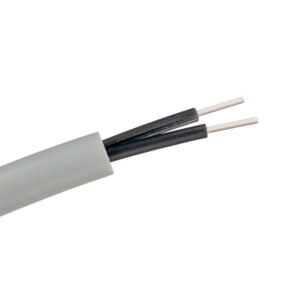

POF/2 is a dual channel multi-mode synthetic optical fiber with core and cladding diameters of 1.0/2.2 mm, respectively. It is primarily used in industrial applications for electromagnetic interference (EMI) immunity and electrical isolation.
It offers many advantages over glass optical fiber due to its ease of installation and lower cost per meter. Typically, RS485, RS232, and RS422 do not require high speeds for industrial communication but prioritize stability and robustness. Multi-mode optical fiber offers exactly that, while also maintaining low costs to fit in the budget.
Technical specifications
| Optical fiber size | Core: 1 mmCladding: 2.2 mm |
|---|---|
| Typical attenuation | 0.19 dB/m @ 650 nm |
| Sheath material | Polyethylene |
| External size | 2.2 mm x 4.4 mm |
|---|
| Operating temperature | -55 °C to +75 °C |
|---|
Full description
POF/2 is a dual channel, multi-mode synthetic optical fiber with a core diameter of 1.0 mm and a cladding diameter of 2.2 mm. It is primarily used in industrial applications for its immunity to electromagnetic interference (EMI) and electrical isolation. It can easily achieve the transmission speeds required by common industrial serial standards, up to 250 kbps. Typically, RS485, RS232, and RS422 do not require high speeds for industrial communication but prioritize stability and robustness.
In a network with heavy electromagnetic interference, common in industrial environments, it is good practice to include two or more optical-to-electrical converters with a fiber-optic link to ensure signal integrity. There are also environments where electrical equipment is prohibited, such as swimming pools, saunas, and fire-prone buildings, where fiber optics become necessary.
The dual channel synthetic optical fiber POF/2HD is also available, featuring a rodent-resistant protective jacket. The protective outer jacket makes the fiber optic cable suitable for underground installation, which may be necessary for outdoor installations or in more complex situations. For critical applications where communication cannot be interrupted, it is standard practice to use synthetic optical fiber cable protected against accidental damage. The thick outer jacket provides additional protection even if objects fall and could damage the fiber optic cable.
Read moreShow less
Single-mode or multi-mode
Single-mode optical fibers are used for high speed transmission applications, up to several Gbps, but they have several disadvantages compared to multi-mode fibers. For example, they allow for a small bending radius, require very precise splicing, and are very expensive. A multi-mode fiber, on the other hand, can achieve lower speeds but is more economical and flexible in terms of installation. For example, standard bench tools are sufficient for termination, and converters use convenient screw-type connectors suitable for hand assembly. However, there are a few simple measures that can be taken to reduce loss and improve communication quality.
Synthetic optical fiber
Single-mode optical fiber can only be made of glass, which certainly has its advantages, primarily the maximum achievable speed and the greater transmission distance. However, the speeds required in industrial applications (often a few tens of kbps) can easily be achieved with plastic fiber. For this reason, in industry or building automation, it is often more cost-effective to use multi-mode synthetic (plastic) optical fiber.
A single run of synthetic optical fiber can cover approximately 100 m, which is sufficient for most indoor or outdoor applications. For longer distances, such as a backbone connecting two different buildings, glass fiber is recommended, as it can span distances of several kilometers, but must be terminated.
Use cases
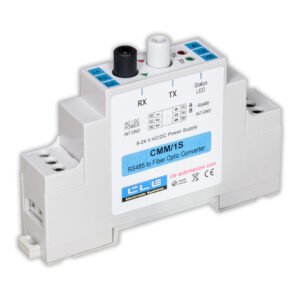
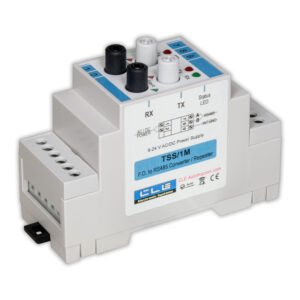
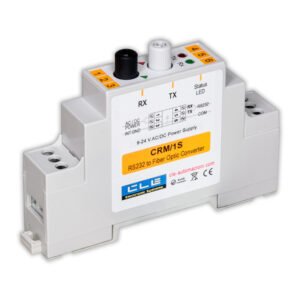
POF/2 synthetic optical fiber can be used in combination with opto-electrical converters and repeaters such as the CMM/1S and TSS/1M, which are suitable for RS485 communication. These are industrial converters designed for DIN-rail mounting, as are the CRM/1S and TSS/1F, which use RS232 and RS422. For connection to a PC via USB or a DB9 connector, we recommend the BTS/1 and DFP/9S, respectively. All combinations of serial standards, optical fiber, and power supply are available in the catalog; however, special requests (such as higher speeds) can be made through the contact form.