Your idea, our expertise
Designing and solving complex problems is the fun part, but we take care of the rest too
Why build a custom board
There are many reasons to build a custom board. In our experience, though, it almost always comes down to these three:
Not on the market
Nothing has those features, or nothing fits in that space. It often happens when size is tight or the working environment is harsh.
Off-the-shelf is not enough
It does too much or too little. It has functions you do not need and lacks the one you do, or it cannot meet the required timing and power consumption. And every compromise to adapt it has a price, in the field and over time.
Cost optimization
A PLC is handy and versatile while the logic is still evolving. Once the automation is defined, a dedicated board does only what it needs to, and costs much less.
What can we do? Everything, almost.
A product is more than a board. Here is a room thermostat made entirely by us, from the first idea to volume production, in all its parts.
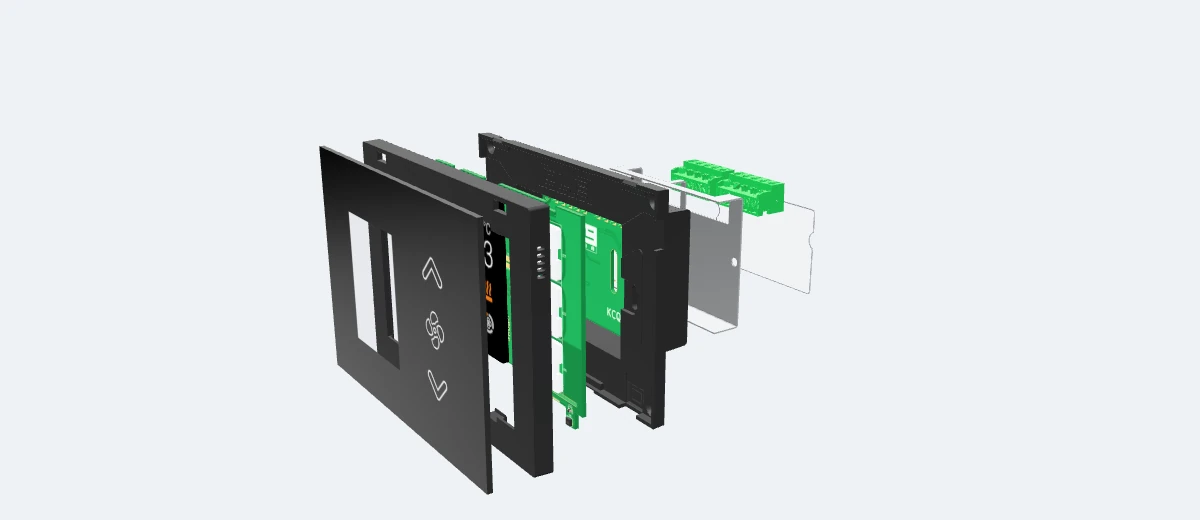
Your browser cannot show the 3D model. The parts are listed below.
- Front glassThe first thing the user touches.
- DisplayGraphics and interface matter as much as the technology.
- BoardThe backbone of the product. Everything goes through here.
- MicrocontrollerThe brain behind the logic and the automation.
- Enclosure3D models and molds, through our partners.
- CoverBrackets and metal parts, where needed.
- LabelProduct identity and mounting instructions.
How we like to start a collaboration
Rather than a supplier-customer relationship, we like to call it a collaboration. We think the idea through together, and we answer for the result.
-
1
The idea and the constraints
We start from what the product must do and what limits it, be it cost, space or the environment it works in.
At this stage what counts is to analyze the problem and understand what is really needed.
-
2
The second opinion
A second opinion, especially a technical one, helps to see whether the idea is heading in the right direction.
And whether it is feasible, which is not a given.
-
3
The specifications
Specifications, requirements, technical documents. Three complicated words for a simple idea: what the board must do, and what it must not do.
And above all what the finished product must do, seen through the eyes of the people who will use it. Is it easy to use?
-
4
And then?
From here on there is no fixed pattern. How we get to the prototype (or the production batch) is decided together, based on the project.
What we commit to deliver
- Practical support from the first contact.
- An honest, expert opinion on the whole product, not only on the board.
- Written specifications, agreed before we start.
- A complete product that works for decades.
- The full project documentation. The board will stay repairable, with or without us.
Frequently asked questions
Do I need a specification document to get started?
No. Most projects start with a description of the problem, by email or phone. If a specification is needed, we help you write it later.
Do you produce small batches?
Yes. The size of the batch is decided by your market, not by a minimum order of ours.
Who owns the project?
You do. Together with the board, we also hand over all the relevant documentation.
Tell us about your idea
Need a hand? A few lines are enough, written the way you would tell a colleague.