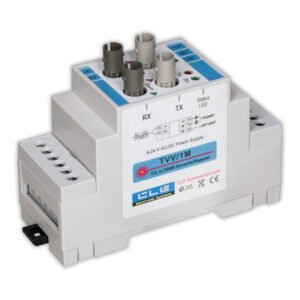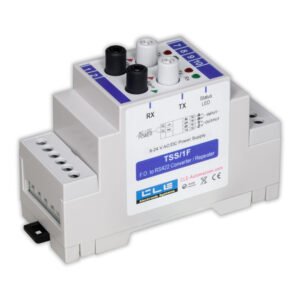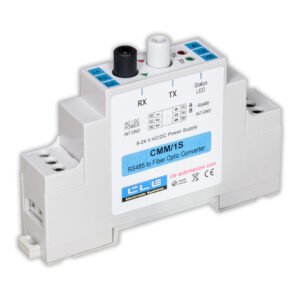

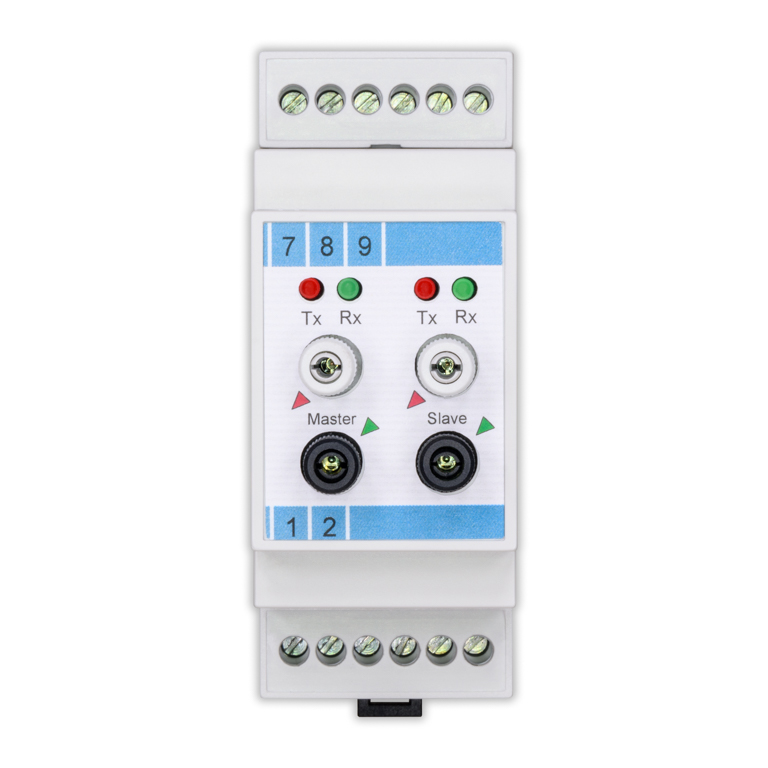
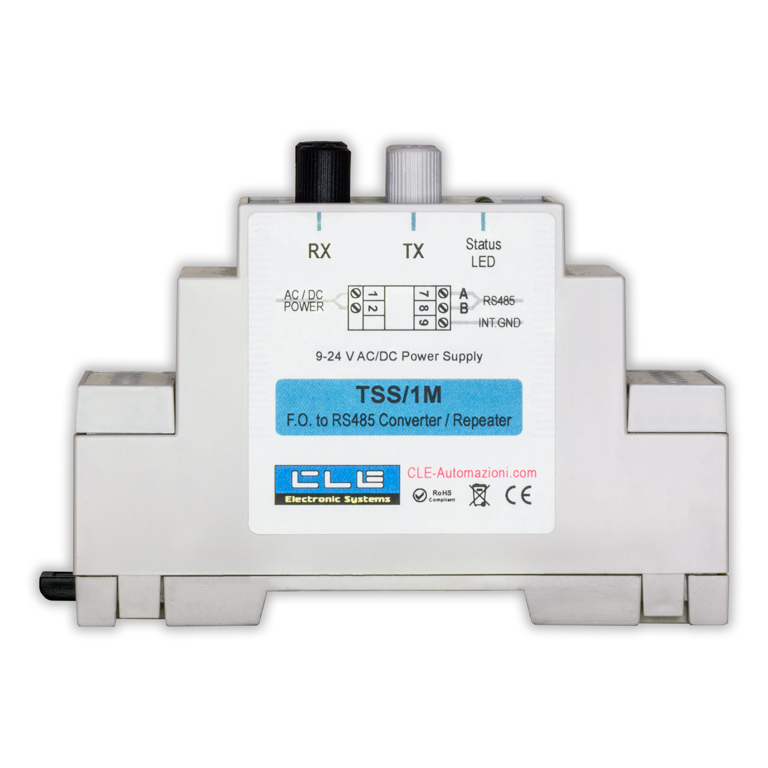
TSS/1M is a synthetic optical fiber RS485 repeater, powered at low voltage AC or DC. It regenerates the signal over a synthetic fiber-optic link and makes it available via electrical RS485 at the same point, extending an optical backbone and allowing a copper RS485 branch to be connected without adding an additional device.
The screw connector greatly simplifies installation; no specialized tools are needed to terminate the fiber.
Frequently asked questions
What is the difference between a repeater and a converter?
A converter changes the transmission medium only once, from copper to fiber. A repeater regenerates the optical signal and retransmits it. Therefore, it is used to extend a link or to create a branch from it.
How many repeaters can be cascaded?
There is no real limit to the number of repeaters. However, each repeater adds a propagation delay, so the upper limit is determined by the latency that the protocol can tolerate: for Modbus RTU, for example, this is the master’s response timeout.
Are there versions for RS232 and RS422?
Yes, our synthetic optical fiber RS485 repeater is available also for different electrical standards: TSS/1R and TSS/1F cover RS232 and RS422, respectively. The optical component is the same.
Technical specifications
| Power supply | 9 - 24 V AC/DC |
|---|---|
| Power consumption | 1 W |
| Serial transmission data rate | 0 - 250 kbps (automatic) |
| Communication type | Half Duplex on balanced line |
|---|---|
| Data direction | Automatic |
| Maximum bus voltage | ± 42 V DC |
| Common mode range | ± 25 V DC |
| ESD protection | ± 15 kV (Human Body Model) - ± 8 kV IEC 61000-4-2 contact |
| Surge protection | Integrated TVS: ± 3 kV IEC 61000-4-5 (surge) - ± 4 kV IEC 61000-4-4 (EFT) |
| Slew rate | Limited, to have an error-free transmission |
| Connector | Screw connector, for simplified installation |
|---|---|
| Fiber mode | Multimode |
| Optical fiber type | Synthetic: POF 2.2 mm - Core 1 mm |
| Maximum transmission distance | 100 m |
| Wavelength | 650 nm |
| DIN Rail | 2 modules |
|---|---|
| Dimensions | 90 mm x 36 mm x 57 mm |
| Weight | 83 g |
| Degree of protection | IP20 |
|---|---|
| Operating temperature | -20 °C to +50 °C |
| Storage temperature | -40 °C to +80 °C |
Full description
TSS/1M is a synthetic optical fiber RS485 repeater, with a low voltage supply. It consists of a synthetic fiber-optic master section with a screw-type connector and an electrical section with an RS485 output. It can be used to extend the transmission distance of a serial communication or to isolate network branches. It can be mounted on a control panel with a 35 mm DIN rail and is very compact, as it occupies only 2 modules.
The synthetic optical fiber RS485 repeater accepts a wide range of low-voltage AC and DC power supplies; it is fully Plug & Play and requires no drivers or DIP switches. This repeater operates in half-duplex mode and automatically detects data direction and transmission speeds up to 250 kbps, making it easy to install in any new or existing system.
Read moreShow less
Working principle
TSS/1M synthetic optical fiber RS485 repeater consists of a master optical section, where the received signal is retransmitted by the slave optical section. The signal is simultaneously converted and transmitted by the RS485 electrical slave section. The response packets received from the slave optical terminals are retransmitted to the master terminals. However, these packets are not converted by the RS485 electrical slave section.
In an installation, it is good practice to install a converter at the beginning of a multi-mode fiber run and an synthetic optical fiber RS485 repeater such as TSS/1M on each floor. This helps reduce issues related to ground potential differences or possible power supply voltage spikes. Optical fiber is a perfect electrical insulator and therefore protects the RS485 bus from the propagation of lightning strikes or other atmospheric discharges.
Optical fiber isolates various branches of a network (such as the floors of a hotel or sections of a photovoltaic system) from electromagnetic interference (EMI) and power surges. Electromagnetic interference is common in these environments; therefore, it is good practice to install two or more optical-to-electrical converters to ensure signal integrity.
Furthermore, a synthetic optical fiber RS485 repeater allows for the regeneration of the electrical signal, thereby improving communication quality.
What is an optical fiber repeater used for?
A synthetic optical fiber RS485 repeater is typically used to integrate multi-mode optical fiber segments into an RS485 serial bus network. There are also environments where electrical equipment is prohibited, such as swimming pools, saunas, and buildings at risk of fire, where optical fiber therefore becomes necessary.
The transmission speed is certainly more limited than glass fiber, but it is still more than sufficient for the few Mbps required in industrial applications. In building automation, controlling modules on an RS485 bus requires a few hundred kbps, and synthetic optical fiber is definitely recommended for isolating different zones of a system.
Protocol
TSS/1M synthetic optical fiber RS485 repeater is completely independent of the protocol used. This means that the repeater is transparent to the communication and can be used with protocols such as Modbus, BACnet, or any proprietary protocol.
This is possible because the repeater operates on electrical levels rather than at the protocol level itself. Therefore, this synthetic optical fiber RS485 repeater can also be used in complex networks where multiple protocols are present simultaneously on the same RS485 bus.
Ease of installation
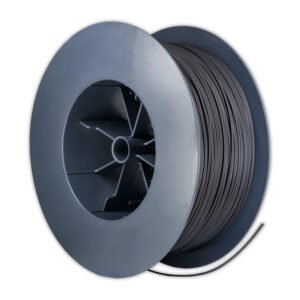
Multi-mode synthetic optical fiber has several advantages over glass fiber; for example, it is more economical and easier to install. It does not need to be terminated; instead, simply use a sharp utility knife to make a clean cut at the ends.
The maximum recommended transmission distance for synthetic optical fiber is 100 m. As long as you stay within these specifications, use good-quality plastic optical fiber, and maintain appropriate bend radius, simply cut the fiber as indicated. Then simply insert the fiber into the repeater and gently screw the connector on with your fingers, no special tools are needed. There’s no need to over-tighten the connectors, as this risks breaking them or damaging the fiber. This speeds up installation and maintenance, which can even be performed by non-specialized personnel.
In more challenging cases, where a few extra meters can make a difference, or where the fiber is not of the highest quality, it may be necessary to take additional steps to minimize insertion loss. You can polish the ends with fine-grit sandpaper, although this step is not necessary in the vast majority of cases.
Versatility
TSS/1M synthetic optical fiber RS485 repeater is also available with other combinations of serial standards and optical fiber, or as a simple converter. The TVV/1M and TQQ/1M repeaters, for example, accept glass optical fiber with a bayonet connector or synthetic optical fiber with a VersaLink connector, respectively. The TSS/1F and TSS/1R, on the other hand, are suitable for various serial standards, namely RS422 and RS232.
CMM/1S industrial serial converter can be used to terminate an optical bus. All combinations of serial standards, fiber optics, and power supply are available in the catalog; however, special requests (such as higher speeds) can be made via the contact form.