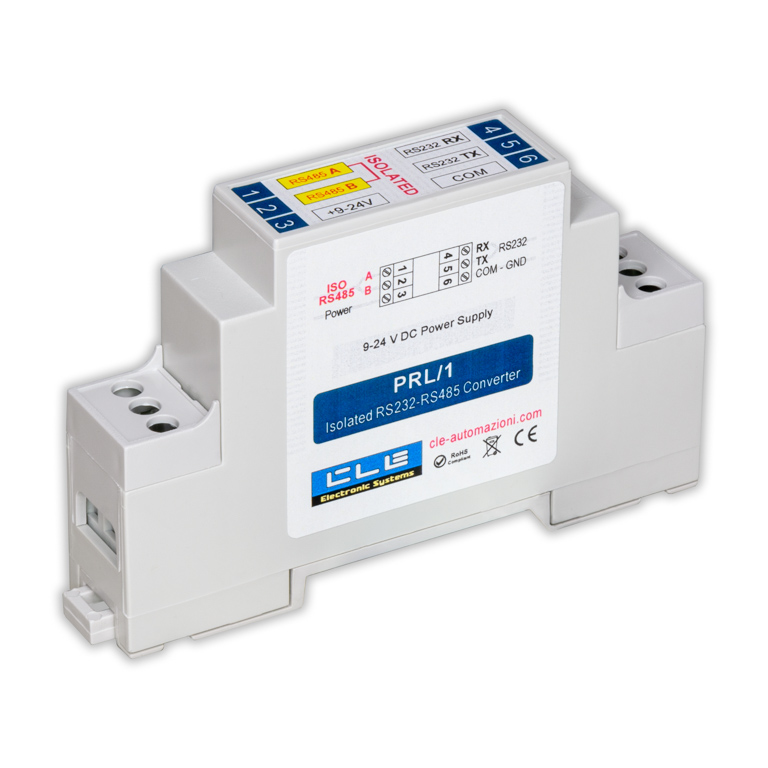
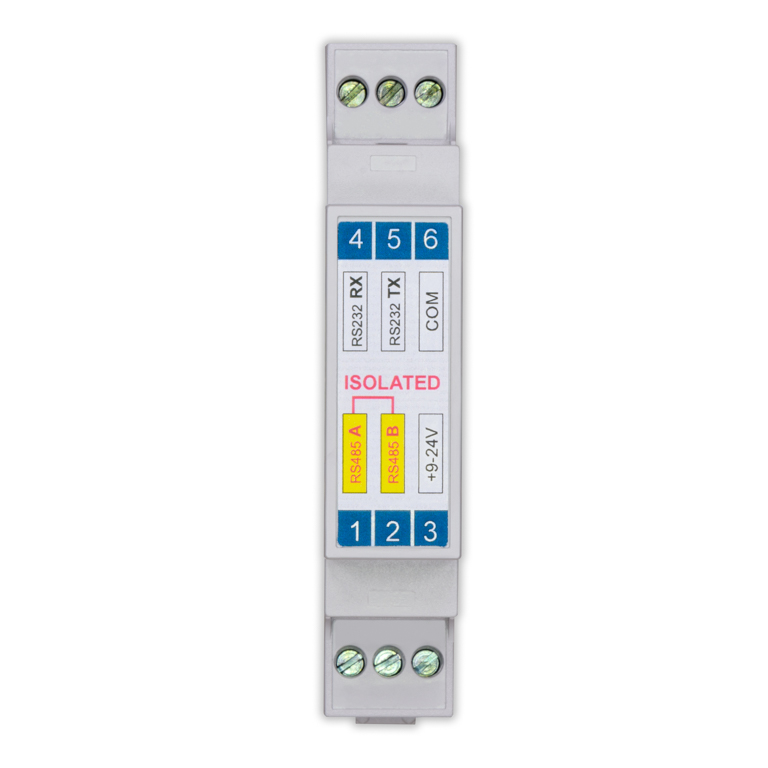
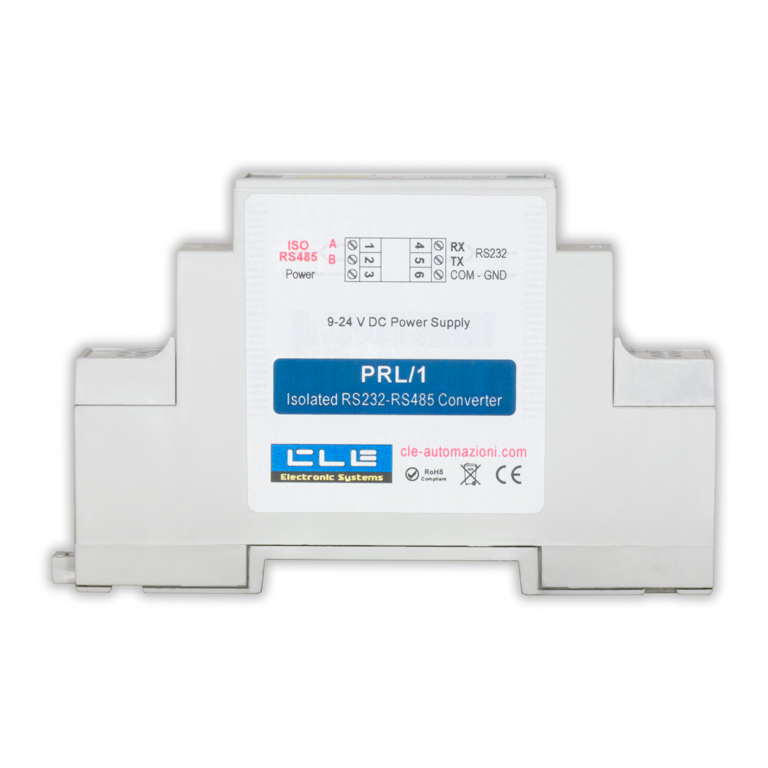
RS232-RS485 isolated converter – PRL/1
PRL/1 is a DIN-rail RS232-RS485 isolated converter, powered at low voltage; it accepts a wide range of low-voltage AC and DC power supplies. It allows isolation of the two serial ports up to 400 V.
It is completely protocol-transparent, so it can be used with any proprietary protocol that operates over RS232.
The RS232 serial port operates in full-duplex mode, while the RS485 serial port operates in half-duplex mode, with automatic data direction. The RS232-RS485 isolated converter automatically detects baud rates up to 250 kbps, so it can be easily installed in any new or existing system. The device is fully Plug & Play and requires no drivers or DIP switches.
Description
PRL/1 is a DIN-rail RS232-RS485 isolated converter, powered at low voltage. This industrial adapter can be used to enable communication between two devices that use different standards, providing isolation up to 400 V, or to extend the transmission distance of a serial communication. It can be mounted on a control panel with a 35 mm DIN rail and it’s very compact, only 1 DIN module. It accepts a wide range of low-voltage AC and DC power supplies, is fully Plug & Play, and requires no drivers or DIP switches.
The RS232 serial port operates in full-duplex mode, while the RS485 serial port operates in half-duplex mode, with automatic data direction. The RS232-RS485 isolated converter automatically detects baud rates up to 250 kbps, so it can be easily installed in any new or existing system.
Use cases
Serial converters are used to connect older equipment that uses RS232 to an RS485 bus. The RS232 standard is still widely used in industrial machinery, but it has a number of issues, including limited transmission distance and low noise immunity. RS485, on the other hand, is more robust, more resistant to interference, and generally more recommended and used for serial buses. RS485 is used above all in building automation, where the bus can extend over hundreds of meters.
Electromagnetic interference is common in industrial environments, so it is good practice to use a standard other than RS232 for serial communication, to ensure signal integrity. Isolation between the two serial ports protects the communication from minor and moderate interference and surges, and thus prevents damage in case of voltage spikes up to 400 V.
In case of heavier electromagnetic interference (EMI), optical fiber is recommended, as it also ensures perfect electrical isolation in case of adverse events such as power surges and lightning strikes. Optical fiber can be single-mode or multi-mode, plastic or glass. For transmission speeds up to a few Mbps, multi-mode synthetic optical fiber (POF) is sufficient: it is very easy to install and lay compared to glass fiber, for example, which requires specific tools for termination.
Protocol
PRL/1 RS232-RS485 isolated converter is completely protocol-independent. This means that the converter is transparent to the communication and can be used with any proprietary protocol.
This is possible because the converter operates at the logic level rather than at the protocol level. Therefore, this RS232-RS485 isolated converter can be used with any computer or machine that communicates via a DB9 port using the RS232 serial standard.
Versatility
The RS232-RS485 isolated converter is also available with 400 V or 560 V isolation, with a 230 V power supply, or with a DB9 connector for RS232. PRM/1 converter, for example, features a non-isolated RS485, in case isolation is not needed. IMC/9R (isolated) and RMC/9R are much more compact and suited to a direct connection to a device with a DB9 connector.
PRLP/1 industrial serial converter is functionally identical to PRL/1 but operates on 230 V mains voltage, as does PRMP/1, which however is not isolated. Other combinations of serial standards, optical fiber, and power supply are available in the catalog, while special requests (such as higher baud rates) can be made via the contact form.
Technical Specifications
Caratteristiche principali
| Alimentazione | 9 – 24 V AC 48/62 Hz 9 – 30 V DC |
|---|---|
| Assorbimento | 1 W |
| Velocità di trasmissione | 0 – 250 kbps (automatica) |
| Ritardo di propagazione | 600 ns (tipico) |
| Tensione di isolamento | 400 V (DIN EN 60747) – 2500 V per 1 minuto (UL 1577) |
RS232
| Communication type | Full duplex |
|---|---|
| RX input voltage | 1.5 V low input threshold – 1.8 V high input threshold (± 25 V max) |
| TX output voltage | ± 5 V (± 5.4 V max) |
| ESD performance RX / TX | ± 15 kV (Human Body Model) – ± 8 kV IEC61000-4-2 contact discharge |
RS485
| Communication type | Half Duplex on a balanced line, with automatic data direction |
|---|---|
| Maximum bus voltage | ± 60 V – ESD ± 16.5 kV (Human Body Model) |
| Common mode range | ± 25 V DC |
| Slew rate | Limited, to have an error-free transmission |
Mechanical features
| DIN Rail | 1 module |
|---|---|
| Dimensions | 90 mm x 18 mm x 57 mm |
| Weight | 52 g |
Working conditions
| Degree of protection | IP20 |
|---|---|
| Operating temperature | -20 °C to +50 °C |
| Storage temperature | -40 °C to +80 °C |