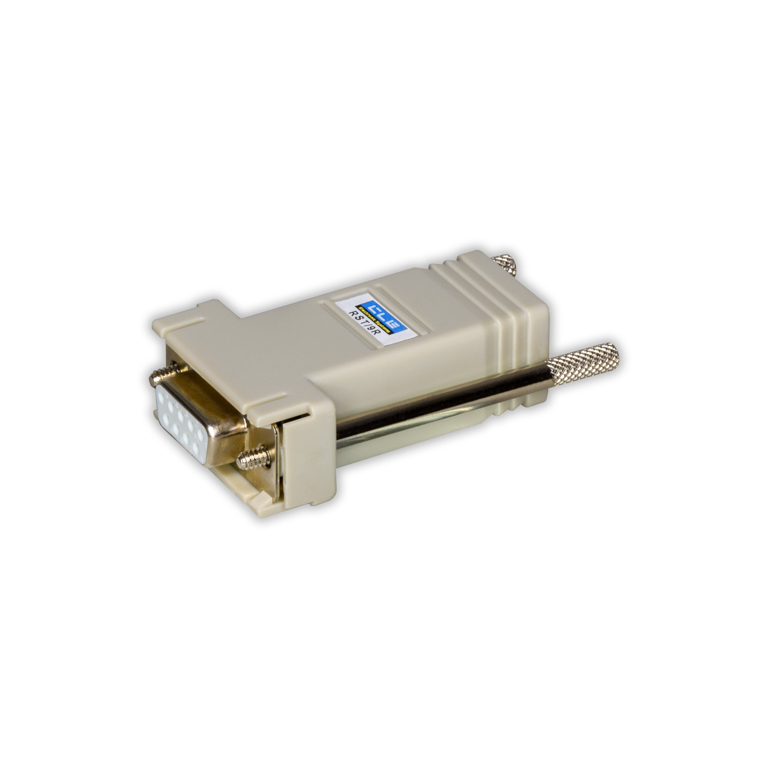
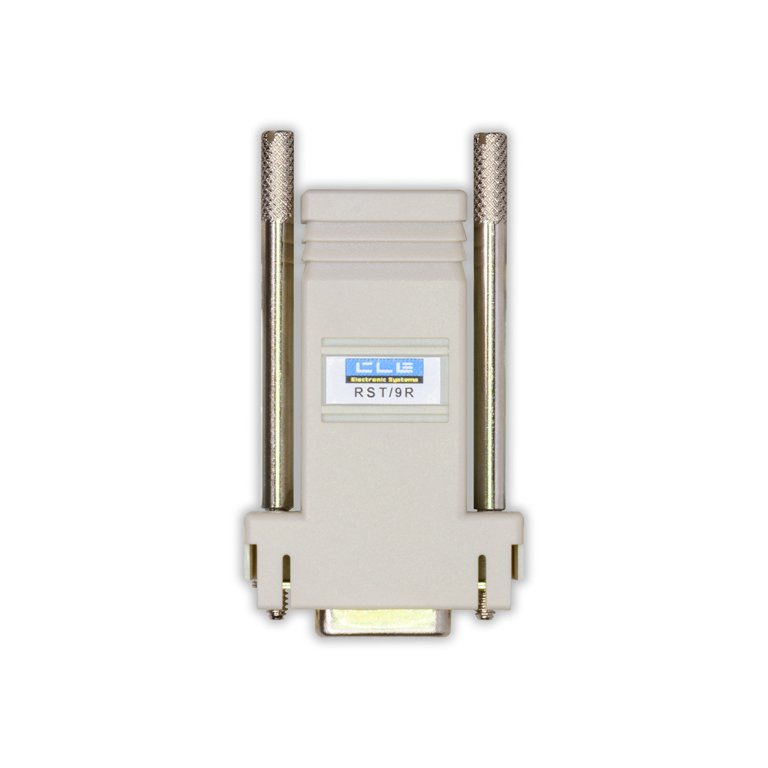
RST/9R is an RS232-to-RS485 RTS converter, designed to convert the RS232 serial standard with a DB9 connector to RS485 with an RJ45 connector. This industrial adapter is self-powered through the D-sub connector. It can be used to connect a PC or industrial device to an RS485 serial bus, converting a DB9 connector with fastening screws to RJ45.
The device is completely Plug&Play and does not require any drivers or DIP switches. The RS232 serial interface operates in Full Duplex mode, while the RS485 serial interface operates in Half Duplex mode, with data direction controlled by the RTS (Request To Send) software signal. The RS232-to-RS485 RTS converter automatically detects transmission speeds of up to 250 kbps, making it easy to install in any new or existing system.
Use cases
The compact size of this converter makes it suitable for installations where space is limited and there is physically no room for a traditional DIN rail converter. Another situation in which this RS232-to-RS485 RTS converter may be required is when a machine has only a DB9 port, or more precisely a D-sub port, and can communicate exclusively through that port. The converter can be securely fastened to the machine on the D-sub side using screws, ensuring maximum communication reliability.
When communication isolation is required to protect the computer against low- or medium-level interference, an isolated converter such as ISC/9R is recommended. However, this device requires an external DC power supply ranging from 5 V to 12 V DC. It can be powered from 5 V to 12 V DC through a standard barrel jack and connected, for example, to a USB port or to a custom power cable. Unlike the RST/9R, the ISC/9R does not feature an RJ45 connector; its RS485 interface uses a 3-pin Mini XLR connector.
Communication interference is common in industrial environments, and it is good practice to protect devices that communicate with external equipment.
Protocol
The RST/9R RS232-to-RS485 RTS converter is completely independent of the protocol being used. This means that the converter is transparent to the communication and can be used with any proprietary protocol.
This is possible because the converter operates at the logic-level interface rather than on the protocol itself. Therefore, this RS232-to-RS485 RTS converter can be used with any computer or machine that communicates through a DB9 port using the RS232 serial standard.
Data direction is controlled through an RTS signal on the D-sub connector, allowing complete communication management using the Flow Control technique.
Versatility
The RS232-to-RS485 RTS converter is also available with automatic data direction control or with different connector options. For example, the RMT/9R converter is functionally identical to the RST/9R, but it features automatic data direction control. The IMC/9R and ISC/9R feature an RS485 interface with a Mini XLR connector, isolated up to 50 V for applications requiring greater protection, with automatic and RTS-controlled data direction, respectively.
The DFP/9S and DFP/9A industrial serial converters feature a synthetic optical fiber output with a screw connector, providing electrical isolation between devices. The catalogue includes all combinations of serial communication standards, optical fiber types, and power supply configurations. Special requirements, such as higher transmission speeds, can be submitted through the contact form.