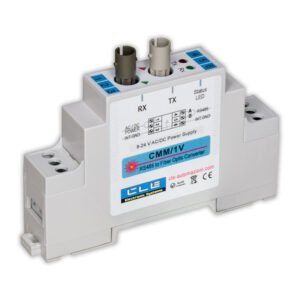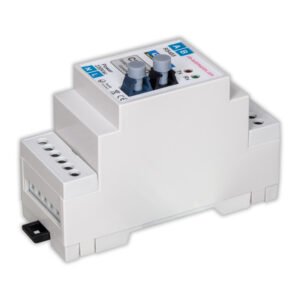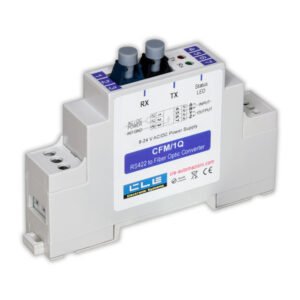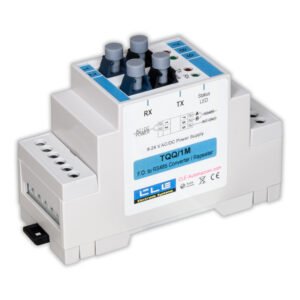


CMM/1Q is a RS485 VersaLink optical fiber converter that converts the standard electrical RS485 bus signal to plastic optical fiber using a VersaLink connector.
It isolates the various branches of a system from electromagnetic interference, electrical surges, or even lightning strikes.
It is completely protocol-transparent, so it can be used with Modbus or any proprietary protocol operating on an RS485 bus.
It accepts a wide range of low-voltage AC and DC power supplies, is fully Plug & Play, and requires no drivers or DIP switches. The RS485 serial interface operates in half-duplex mode and automatically detects data direction and baud rates up to 40 kbps, so it can be easily installed in any new or existing system.
Technical specifications
| Power supply | 9 - 24 V AC/DC |
|---|---|
| Power consumption | 1 W |
| Communication type | Half Duplex on balanced line |
|---|---|
| Data direction | Automatic |
| Maximum bus voltage | ± 42 V DC |
| Common mode range | ± 25 V DC |
| ESD protection | ± 15 kV (Human Body Model) - ± 8 kV IEC 61000-4-2 contact |
| Surge protection | Integrated TVS: ± 3 kV IEC 61000-4-5 (surge) - ± 4 kV IEC 61000-4-4 (EFT) |
| Slew rate | Limited, to have an error-free transmission |
| Connector | Versatile Link |
|---|---|
| Fiber mode | Multimode |
| Optical fiber type | Synthetic: POF 2.2 mm - Core 1 mmHard Clad Silica (HCS): 200 / 230 μm |
| Maximum transmission distance | Synthetic: 100 mHard Clad Silica (HCS): 500 m |
| Transmission data rate | 0 - 40 kbps (automatic) |
| Wavelength | 660 nm |
| DIN Rail | 1 module |
|---|---|
| Dimensions | 90 mm x 18 mm x 57 mm |
| Weight | 52 g |
| Degree of protection | IP20 |
|---|---|
| Operating temperature | -20 °C to +50 °C |
| Storage temperature | -40 °C to +80 °C |
Full description
CMM/1Q is a RS485 VersaLink optical fiber converter that converts RS485 electrical serial bus standard to plastic optical fiber with a Versatile Link connector. It can be used to extend the transmission distance of a serial communication or to isolate network branches. It can be mounted on a control panel with a 35 mm DIN rail and it's very compact, only 1 DIN module.
CMM/1Q RS485 VersaLink optical fiber converter accepts a wide range of low-voltage AC and DC power supplies; it is fully Plug & Play and requires no drivers or DIP switches. The RS485 serial interface operates in half-duplex mode and automatically detects data direction and transmission speeds up to 40 kbps, making it easy to install in any new or existing system.
Read moreShow less
Use cases
A RS485 VersaLink optical fiber converter is typically used to integrate multi-mode optical fiber links into an RS485 serial bus network. There are also environments where electrical equipment is prohibited, such as swimming pools, saunas, and buildings at risk of fire, where fiber optics therefore become necessary.
The transmission speed is certainly more limited than glass fiber, but it is still more than sufficient for the few Mbps required in industrial applications. In building automation, controlling modules on an RS485 bus requires a few hundred kbps, and synthetic optical fiber is definitely recommended for isolating different zones of a system.
Advantages
In a system, it is good practice to install a RS485 VersaLink optical fiber converter at the beginning of a multi-mode fiber run, and a repeater such as the TQQ/1M on each floor. This helps reduce issues related to ground potential differences or possible power surges. Optical fiber is a perfect electrical insulator and therefore protects the RS485 bus from the propagation of lightning strikes or other atmospheric discharges.
Fiber optics isolate various branches of a network, such as the floors of a hotel or sections of a photovoltaic system, from electromagnetic interference (EMI) and power surges. Electromagnetic interference is common in these environments, so it is good practice to install two or more optical-to-electrical converters to ensure signal integrity.
Furthermore, a RS485 VersaLink optical fiber converter allows for the regeneration of the electrical signal, thereby improving communication quality.
Protocol
CMM/1Q RS485 VersaLink optical fiber converter is completely independent of the protocol used. This means that the converter is transparent to the communication and can be used with protocols such as Modbus, BACnet, or any proprietary protocol.
This is possible because the converter operates at the logical levels, rather than at the protocol level itself. Therefore, this RS485 VersaLink optical fiber converter can also be used in complex networks where multiple protocols are present simultaneously on the same RS485 bus.
Versatility
The RS485 VersaLink optical fiber converter is available with other combinations of serial and fiber optic standards, or with a 230 V power supply. The CMM/1V and CMM/1S converters, for example, accept glass fiber with a bayonet connector or synthetic fiber with a screw connector, respectively. The CRM/1Q and CFM/1Q, on the other hand, are suitable for various serial standards, namely RS232 and RS422.
The CMP/1Q RS485 VersaLink optical fiber converter is functionally identical to CMM/1Q but operates on 230 V AC. All combinations of serial standards, optical fiber types, and power supply options are available in the catalog; however, special requests (such as higher data rates) can be made via the contact form.