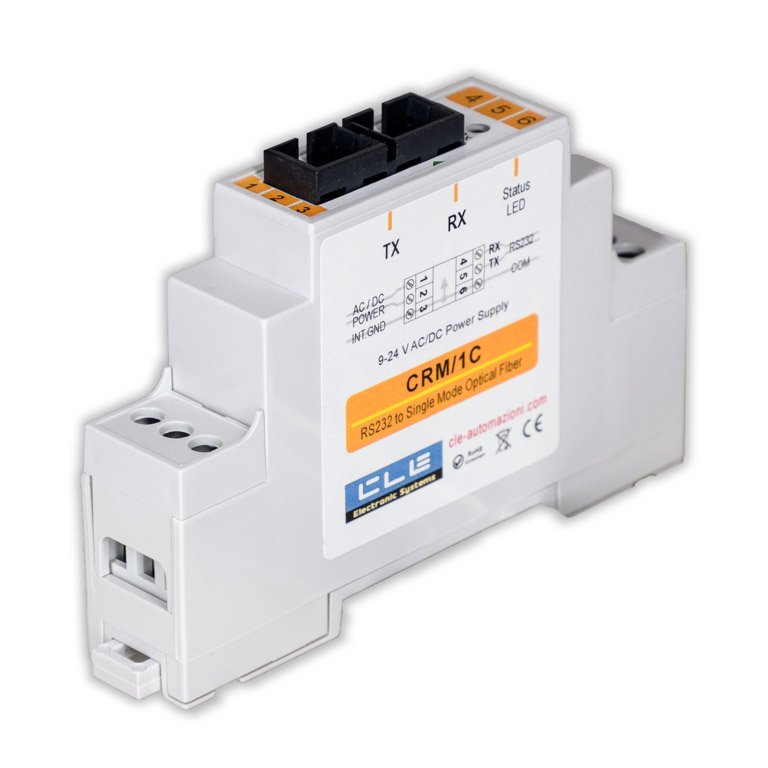
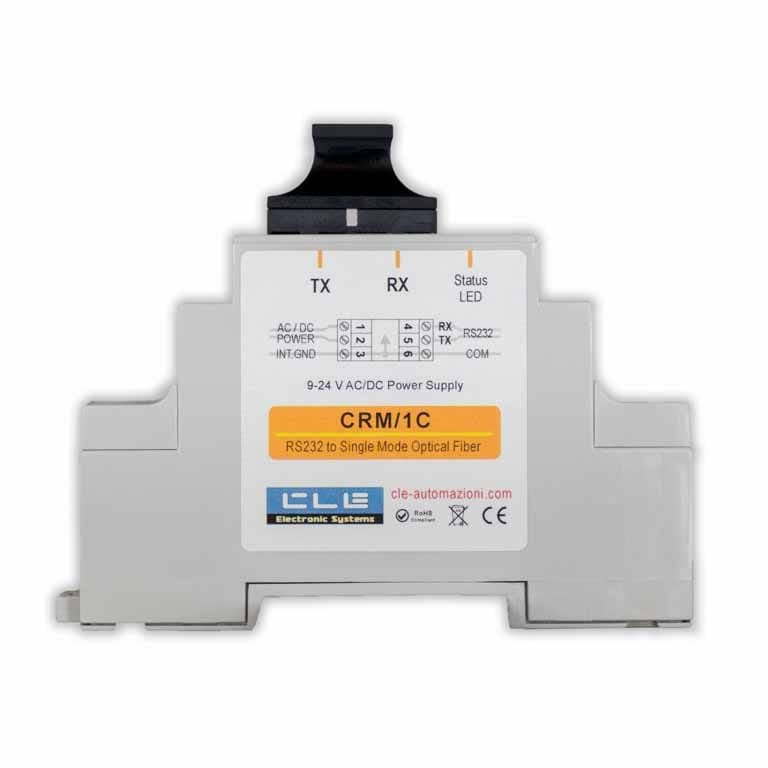
RS232 single-mode optical fiber converter – CRM/1C
CRM/1C is an RS232 single-mode optical fiber converter, used when the serial link needs to exceed the effective range of copper wiring or pass through an area with electrical interference. It mounts on a 35 mm DIN rail, occupying a single module, and automatically detects baud rates up to 250 kbps, allowing it to be integrated into an existing system without any configuration or DIP switches.
It is completely protocol-transparent, so it can be used with any proprietary protocol operating on an RS232 bus.
FAQ
What is the maximum transmission distance?
Up to 20 km per single point-to-point link.
Single-mode or multi-mode fiber: which is better?
It depends on the application. Single-mode fiber is required for long distances, but multi-mode fiber is easier to use.
Can I connect it to CRM/1V?
No, the fiber is different and not compatible, and so is the wavelength.
Which fiber and connectors are needed?
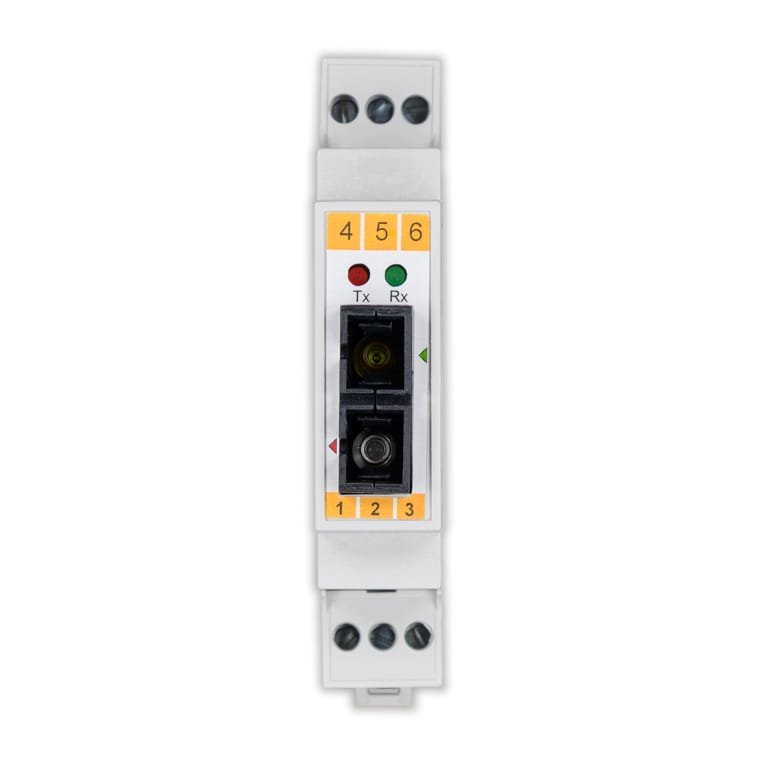
One 9/125 µm single-mode fiber for TX and one for RX, with a duplex SC connector or two separate simplex SC connectors.
Does it need to be configured?
No, it automatically detects the baud rate up to 250 kbps, and accepts a wide range of low-voltage AC and DC power supplies.
Description
CRM/1C is an RS232 single-mode optical fiber converter that converts RS232 electrical serial bus standard to single-mode optical fiber with an SC connector. It can be used to extend the transmission distance of a serial communication or to isolate network branches. It can be mounted on a control panel with a 35 mm DIN rail and it’s very compact, only 1 DIN module.
CRM/1C RS232 single-mode optical fiber converter accepts a wide range of low-voltage AC and DC power supplies; it is fully Plug & Play and requires no drivers or DIP switches. The RS232 serial interface operates in full-duplex mode and automatically detects the transmission speed up to 250 kbps, making it easy to install in any new or existing system.
What is an RS232 to optical fiber converter used for?
An RS232 single-mode optical fiber converter is typically used to create a communication backbone between two or more buildings in an RS232 serial bus network. When multi-mode fiber is not enough, single-mode optical fiber is the right choice, because the reachable distance is much greater. The transmission distance can reach 20 km with single-mode optical fiber, against 2 km with multimode glass fiber. Such distances are often unnecessary, but an RS232 single-mode optical fiber converter can be useful when the fiber has already been laid, and single-mode fiber is increasingly common because it is more versatile, as it can also be used for data transmission at several Gbps.
There are also environments where electrical equipment is prohibited, such as swimming pools, saunas, and buildings at risk of fire, where fiber optics therefore become necessary.
Advantages
In a system, it is good practice to install an RS232 single-mode optical fiber converter at the beginning of a fiber run. This helps reduce issues related to ground potential differences or possible power surges. Optical fiber is a perfect electrical insulator and therefore protects the RS232 bus from the propagation of lightning strikes or other atmospheric discharges.
Fiber optics isolate various branches of a network, such as the floors of a hotel or sections of a photovoltaic system, from electromagnetic interference (EMI) and power surges. Electromagnetic interference is common in these environments, so it is good practice to install two or more optical-to-electrical converters to ensure signal integrity.
Furthermore, an RS232 single-mode optical fiber converter allows for the regeneration of the electrical signal, thereby improving communication quality.
Protocol
CRM/1C RS232 single-mode optical fiber converter is completely independent of the protocol used. This means that the converter is transparent to the communication and can be used with any proprietary protocol.
This is possible because the converter operates at the logical levels, rather than at the protocol level itself. Therefore, this RS232 single-mode optical fiber converter can also be used in complex networks where multiple protocols are present simultaneously on the same RS232 bus.
Installation
Single-mode optical fiber is more difficult to install than multi-mode fiber (synthetic or glass), because it requires dedicated termination tools and softer bend radius.
However, the versatility of single-mode fiber is quickly gaining ground and replacing multimode optical fiber in new installations, which makes an RS232 single-mode optical fiber converter necessary. The push-pull SC connector is very easy to use, and its snap-in latch ensures a secure connection.
For these reasons, single-mode optical fiber is often used only as a communication backbone over long distances, while multi-mode or synthetic plastic optical fiber (POF) is preferred for shorter runs because it is easier to install.
Versatility
The RS232 single-mode optical fiber converter is available with other combinations of serial and fiber optic standards. CRM/1S and CRM/1V converters, for example, accept synthetic fiber with a screw-type connector or multi-mode glass fiber with an ST connector, respectively. CMM/1C and CFM/1C, on the other hand, are suitable for various serial standards, namely RS485 and RS422.
All combinations of serial standards and optical fiber types are available in the catalog; however, special requests (such as higher data rates) can be made via the contact form.
Technical Specifications
Main features
| Power supply | 9 – 24 V AC 48/62 Hz 9 – 30 V DC |
|---|---|
| Power consumption | 1 W |
| Serial transmission data rate | 0 – 250 kbps (automatic) – higher data rates on request |
RS232
| Communication type | Full duplex |
|---|---|
| RX input voltage | 1.5 V low input threshold – 1.8 V high input threshold (± 25 V max) |
| TX output voltage | ± 5 V (± 5.4 V max) |
| ESD performance RX / TX | ± 15 kV (Human Body Model) – ± 8 kV IEC61000-4-2 contact discharge |
SC (Square Connector)
| Fibra ottica accettata | Vetro: 9 / 125 μm |
|---|---|
| Massima distanza di trasmissione | 20 km |
| Lunghezza d'onda | 1310 nm |
Mechanical features
| DIN Rail | 1 module |
|---|---|
| Dimensions | 90 mm x 18 mm x 57 mm |
| Weight | 52 g |
Working conditions
| Degree of protection | IP20 |
|---|---|
| Operating temperature | -20 °C to +50 °C |
| Storage temperature | -40 °C to +80 °C |